Table Of Content
- Save More on Every Order – Grab the Latest Coupons & Deals
- Why Smart Body Composition Tracking Matters
- Hume Health: What It Adds
- Smart Scale vs Regular Scale: Key Differences
- What to Know About Accuracy
- Is the Hume Pod Worth Considering?
- Pros and Cons
- Save More on Every Order – Grab the Latest Coupons & Deals
- Frequently Asked Questions
- Is a smart body composition scale better than a regular scale?
- How accurate are body composition scales?
- What does the Hume Pod measure?
- Does Hume require a paid app subscription?
- Can I use a body composition scale for medical decisions?
- Related Resources
- Conclusion
A regular scale answers one basic question: how much do you weigh? A smart body composition scale provides more context, such as estimated body fat, muscle mass, water, and other metrics. That difference can matter when a single weight reading does not explain what is changing over time. In a smart body composition scale vs regular scale comparison, the right choice depends on whether you only need a simple weight measurement or want broader wellness and fitness data.
Hume Health approaches this need with the Hume Pod, an at-home body composition device that combines a scale with handle-based sensors and an app. The goal is more informative home tracking, not professional assessment.
Save More on Every Order – Grab the Latest Coupons & Deals
Why Smart Body Composition Tracking Matters
A regular bathroom scale measures total body weight. It cannot directly tell you how that number relates to fat mass, muscle mass, or body water.
Body composition devices use bioelectrical impedance analysis (BIA) to estimate additional measurements. Research shows that BIA can be useful, but readings can be influenced by hydration, food and drink, physical activity, body position, and temperature. Consistent testing conditions therefore matter when following trends.
This makes a smart scale more useful as a trend-tracking tool than as a source of perfectly precise day-to-day numbers.
Hume Health: What It Adds
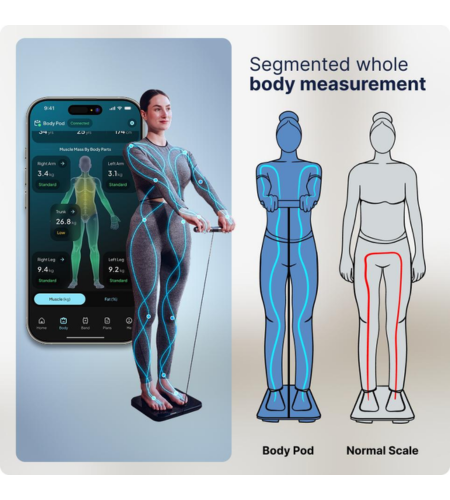
The Hume Pod is designed to go beyond basic weight measurement. According to Hume Health, it uses eight-frequency sensors and a handle to collect full-body measurements, while the Hume app organizes results and tracks changes over time. Hume says the device tracks 45 body composition measurements, including body fat, muscle mass, water-related metrics, visceral fat, metabolic age, and heart-rate information.
The company also says the app can connect with Apple Health, Fitbit, Garmin, and Google Health Connect. That can be useful for people who already keep wellness information in a digital ecosystem.
Smart Scale vs Regular Scale: Key Differences
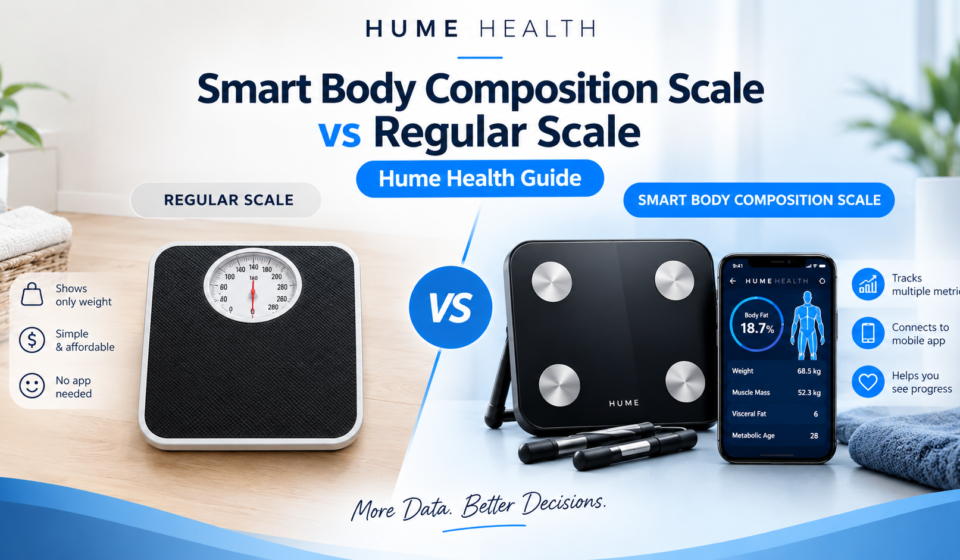
Regular scale
- Measures body weight.
- Simple to use.
- Limited data.
Smart body composition scale
- Measures weight and other metrics.
- Tracks trends through an app.
- Provides more information.
The main advantage is information.
What to Know About Accuracy
More measurements do not automatically mean every number is exact. BIA estimates depend on the device, prediction equations, and measurement conditions. Expert guidance notes that hydration, recent food or fluid intake, exercise, posture, and other factors can affect reliability.
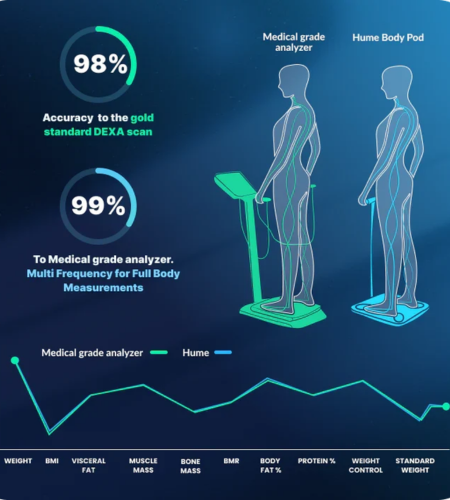
Hume Health states that the Hume Pod has been compared with DEXA and reports 98% accuracy on its product pages. It also says its accuracy was independently verified and offers a 45-day trial or return policy. These are manufacturer claims, so they should be treated as product information rather than a guarantee that every individual reading will match a clinical test.
For consistent tracking, use similar conditions and focus on longer-term trends.
Is the Hume Pod Worth Considering?
The Hume Pod may suit someone who wants more information than a basic scale provides and is comfortable using an app. It can be useful for general wellness, fitness routines, and body-composition trend tracking at home.
There are trade-offs. A regular scale is cheaper and simpler if weight is the only measurement you need. The Hume Pod adds sensors, app tracking, and more metrics, which means more information to interpret.
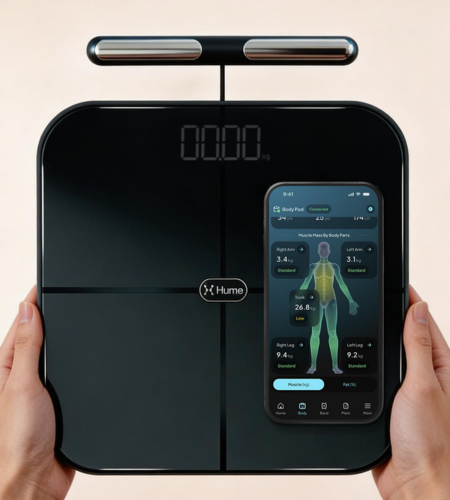
At the time of research, Hume’s official U.S. product page listed the Hume Pod at $229, reduced from a displayed $352 price. The page also listed a free app, free global shipping, and a 45-day refund policy. Pricing, availability, and shipping terms can change, so check the official store before purchasing.
Pros and Cons
Pros
- Provides more information than a regular scale.
- Tracks multiple body-composition measurements.
- App-based trend tracking is easy to review.
- Designed for repeatable home measurements.
Cons
- Costs more than a basic scale.
- BIA estimates can vary with measurement conditions.
- More metrics require more interpretation.
- It is not a substitute for professional medical assessment.
Save More on Every Order – Grab the Latest Coupons & Deals
Frequently Asked Questions
Is a smart body composition scale better than a regular scale?
Not necessarily. A regular scale is better for simplicity, while a body composition scale is more suitable if you want additional estimated metrics and trend data.
How accurate are body composition scales?
Accuracy varies by device and measurement conditions. BIA can be useful, but hydration, food, exercise, posture, and other factors can influence results.
What does the Hume Pod measure?
Hume says the Hume Pod tracks 45 body composition measurements, including body fat, muscle mass, water-related measures, visceral fat, metabolic age, and heart-rate information.
Does Hume require a paid app subscription?
Hume says its core app is free, with premium features available separately for users who want additional coaching and personalized insights.
Can I use a body composition scale for medical decisions?
Home BIA readings are better viewed as wellness and trend information, not a diagnosis. For a health concern requiring clinical evaluation, consult a qualified healthcare professional.
Related Resources
For a broader look at the device and its features, see this Hume Health review and smart health tracker guide.
Conclusion
In a smart body composition scale vs regular scale comparison, the biggest difference is the amount of information available. A regular scale keeps things simple with body weight, while a smart body composition device can provide additional estimates and help you follow trends over time.
The Hume Pod is worth exploring if you want broader at-home tracking and are comfortable interpreting BIA-based data. Review the current specifications, price, return terms, and app features before deciding whether it fits your needs. For the latest product information, visit the official Hume Health store.