Table Of Content
- Save More on Every Order – Grab the Latest Coupons & Deals
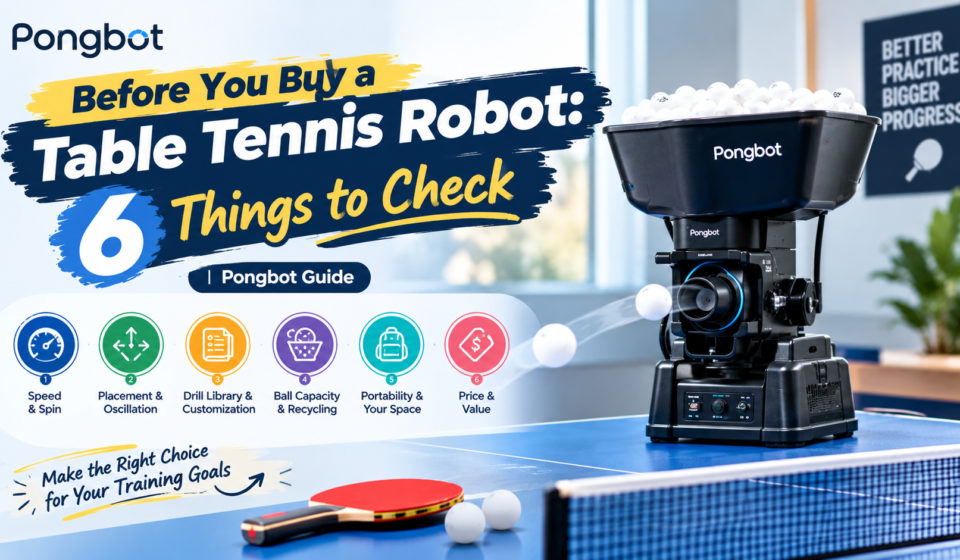
- 1. Check Speed, Spin, and Ball Frequency
- 2. Look at Placement and Oscillation
- 3. Check the Drill Library and Customization
- 4. Consider Ball Capacity and Recycling
- 5. Match the Robot to Your Space
- 6. Compare Price With the Features You Need
- How Pongbot Fits the Buying Decision
- Save More on Every Order – Grab the Latest Coupons & Deals
- Frequently Asked Questions
- Is a table tennis robot good for beginners?
- What should I look for in a table tennis robot?
- Is the Pongbot Nova S Pro portable?
- Do Pongbot robots use standard table tennis balls?
- Is a more expensive robot always better?
- Related Resources
- Conclusion
Buying a table tennis robot can seem simple until you compare speed, spin, ball capacity, placement control, drill options, portability, and price. The right machine should match the way you actually practice—not simply have the biggest specification sheet. Before choosing a table tennis robot, identify the features that will make your sessions useful, repeatable, and convenient.
Pongbot offers several table tennis training robots, from the portable Nova S Pro to the more advanced Omni S Pro and floor-standing Halo S Pro. Checking six practical factors can help you choose a robot that fits your table, skill level, training goals, space, and budget.
Save More on Every Order – Grab the Latest Coupons & Deals:
1. Check Speed, Spin, and Ball Frequency
Start with the basics: how fast can the robot deliver balls, how much spin can it produce, and how frequently can it feed them? These settings determine the range of drills you can perform.
Pongbot’s Nova S Pro lists ball speeds of 2–15 m/s, a frequency of 30–90 balls per minute, and up to 60 r/s of spin. It supports nine spin variations. This can suit players who want structured repetition in a compact machine.
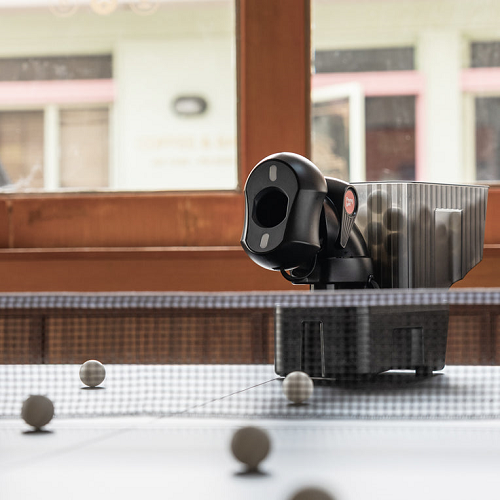
More advanced models offer broader control. The Halo S Pro reaches up to 100 r/s and supports 360° spin adjustment. However, maximum specifications are not automatically necessary for beginners.
2. Look at Placement and Oscillation
A useful robot should be able to send balls to different areas of the table. Placement control can support footwork, forehand-backhand transitions, movement patterns, and varied stroke practice.
Check whether the machine offers manual or automatic oscillation and whether vertical or side placement can be adjusted. Nova S Pro uses manual left-right oscillation, while Halo S Pro provides automatic continuous left-right and vertical-side adjustment.
For basic consistency, simpler placement may be enough. Advanced movement drills can benefit from wider, automated control.
3. Check the Drill Library and Customization
Preset drills save time when you do not want to design every session yourself. Custom drills are useful when you want to focus on specific weaknesses.
Pongbot lists 264+ built-in drills for Nova S Pro and 702+ for Halo S Pro. The Halo S Pro also supports personalized routines and visualized ball paths. When comparing machines, look beyond the number of drills. Check whether you can adjust speed, spin, placement, and sequences in ways that match your training goals.
4. Consider Ball Capacity and Recycling
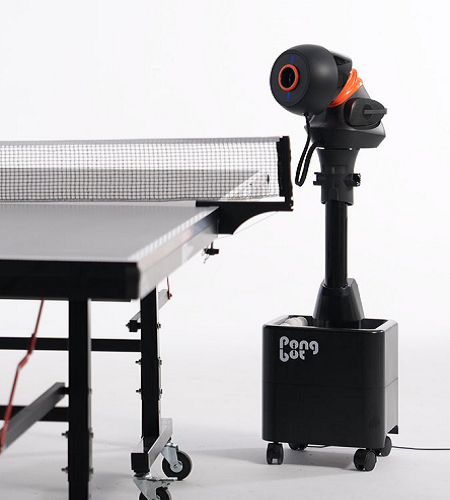
Ball capacity affects how often you need to stop and reload. For shorter home sessions, a smaller hopper may be practical. Longer sessions benefit from greater capacity and, where available, ball recycling.
Nova S Pro is listed with a 150-ball capacity. Halo S Pro holds 250 balls and includes an integrated recycling system, which can reduce interruptions.
Pongbot also states that its robots work with standard 40+ table tennis balls without a specific brand or material requirement.
5. Match the Robot to Your Space
A powerful robot is not automatically the best home option. Consider where you will store it, how often you will move it, and how much room you have around the table.
Nova S Pro is designed as a portable unit and has a listed net weight of 4 kg. Halo S Pro is a floor-standing model with a listed net weight of 11 kg, making it more suitable for a dedicated training setup.
Measure your storage area and consider your table layout before choosing a model.
6. Compare Price With the Features You Need
Compare the price with the capabilities you will actually use. At the time of checking, Pongbot’s official store listed Nova S Pro at $299.99, Omni S Series from $749.99, and Halo S Pro at $1,499.99. Prices can change.
Nova S Pro emphasizes portability and structured solo practice, while the higher-tier models offer deeper control and more advanced training features. Paying more makes sense only when those features match your goals.
How Pongbot Fits the Buying Decision
Pongbot’s table tennis lineup covers different approaches to solo practice. The models vary in spin control, placement, drill libraries, ball capacity, and portability.
That makes the lineup easier to evaluate after you identify your priorities. If portability matters most, a compact model may be enough. If you want advanced placement and more complex routines, a higher-tier machine may be worth considering.
Save More on Every Order – Grab the Latest Coupons & Deals:
Frequently Asked Questions
Is a table tennis robot good for beginners?
Yes. A robot can provide repeatable ball delivery for practicing basic strokes and consistency. Beginners can prioritize simple controls and easy setup.
What should I look for in a table tennis robot?
Focus on speed, spin, placement, oscillation, drill customization, ball capacity, portability, and price. Your training style should determine which features matter most.
Is the Pongbot Nova S Pro portable?
Yes. Pongbot describes it as backpack-portable, with a listed net weight of 4 kg.
Do Pongbot robots use standard table tennis balls?
Pongbot states that its robots can use standard 40+ balls without requiring a specific brand or material.
Is a more expensive robot always better?
No. Higher-priced models may offer more advanced controls, but a simpler machine can be a better fit for players who mainly need repetition and solo practice.
Related Resources
For a broader look at the products, see the Pongbot review and 2026 table tennis robot guide. You can also explore the official Pongbot table tennis robot collection.
Conclusion
Choosing a table tennis robot starts with your training goals. Speed and spin matter, but placement, drill customization, ball capacity, portability, and price can be equally important.
Pongbot offers several models to compare, from portable practice equipment to advanced floor-standing systems. Review the specifications and current pricing on the official store before deciding which table tennis robot fits your routine.