Table Of Content
- 1. Understanding Medical-Grade and Drugstore Skincare
- 2. Compare Ingredients and Formulations
- 3. Consider Product Selection and Availability
- 4. Understand Pricing and Overall Value
- 5. Choose Products Based on Your Skincare Goals
- How Skincare Essentials Fits Into Your Skincare Routine
- Pros and Cons of Each Skincare Category
- Frequently Asked Questions
- Is medical-grade skincare better than drugstore skincare?
- Is medical-grade skincare FDA-approved?
- Can drugstore skincare be effective?
- Is expensive skincare always better?
- Where can I explore professional skincare products?
- Conclusion
Choosing the right skincare products can feel confusing, especially when you are comparing expensive professional formulas with affordable drugstore options. Both categories offer cleansers, moisturizers, serums, and treatments designed to support healthier-looking skin, but their ingredients, formulations, and product positioning can differ.
The discussion around medical-grade vs drugstore skincare often creates the impression that more expensive products automatically deliver better results. However, the right choice depends on your skin type, individual concerns, ingredient preferences, and budget.
Understanding these differences can help you make more informed decisions. Whether you are building a simple daily routine or exploring advanced skincare treatments, knowing what to look for matters more than choosing a product based on its price or label.
1. Understanding Medical-Grade and Drugstore Skincare
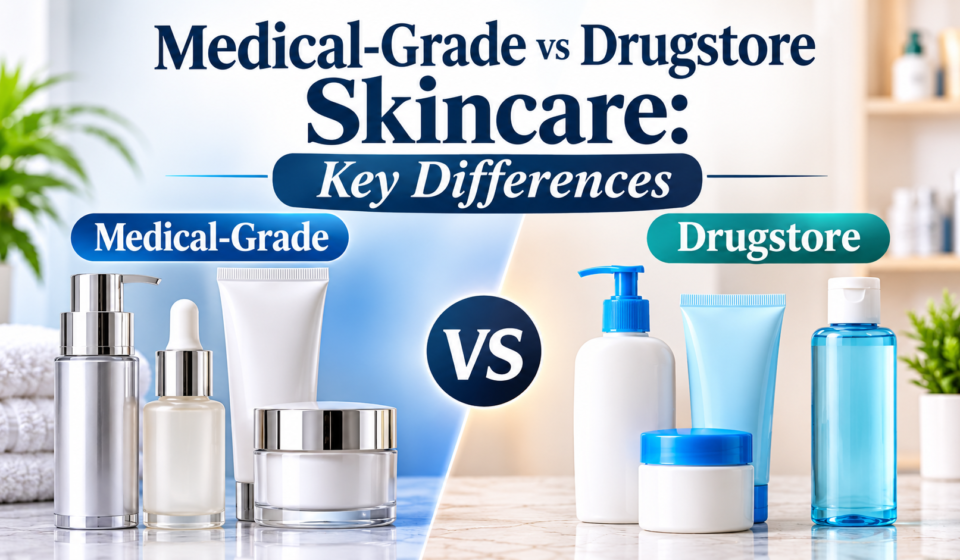
Medical-grade skincare generally refers to products marketed through professional skincare channels, including dermatology practices, aesthetic clinics, and specialized retailers. These products often focus on targeted skincare concerns and may feature carefully developed ingredient combinations.
Drugstore skincare is designed for everyday consumers and is widely available through pharmacies, supermarkets, and beauty retailers. It includes basic products such as facial cleansers, moisturizers, sunscreens, and targeted treatments.
One important detail is that medical-grade is not a separate FDA-recognized category. The label itself does not guarantee FDA approval, superior effectiveness, or better product safety.
Both categories can contain useful ingredients, and individual formulations should always be evaluated on their own merits.
2. Compare Ingredients and Formulations
Ingredients are one of the most important factors when comparing skincare products.
Medical-grade formulas may combine active ingredients such as retinoids, vitamin C, peptides, exfoliating acids, and hydrating ingredients. Their formulations may be designed to address specific concerns, depending on the product.
Drugstore skincare also offers products containing many of these familiar ingredients. For example, affordable moisturizers can contain hyaluronic acid, ceramides, and glycerin to support skin hydration.
When comparing formulations, consider:
- Active ingredients and their concentrations when disclosed.
- The overall ingredient list.
- Product suitability for sensitive or reactive skin.
- Whether the formulation addresses your specific concerns.
- Directions for use and recommended precautions.
A higher price does not automatically mean a better ingredient combination. Reading product labels is a more reliable starting point.
3. Consider Product Selection and Availability
Drugstore skincare makes it relatively easy to find everyday essentials without visiting a professional skincare retailer.
You can usually find different options for dry, oily, combination, and sensitive skin. This makes it convenient to build a basic skincare routine using accessible products.
Medical-grade skincare often has a more specialized product selection. Depending on the retailer, shoppers may find professional serums, advanced moisturizers, exfoliating treatments, and products from established skincare brands.
Skincare Essentials offers several relevant categories, including:
- Cleansers and facial washes.
- Moisturizers and hydration products.
- Treatment serums.
- Toners and exfoliating products.
- Eye treatments.
- Facial sunscreens.
Its product selection includes brands such as SkinMedica, Obagi, and ZO Skin Health, providing options for shoppers interested in exploring professional skincare products.
4. Understand Pricing and Overall Value
Price is another noticeable difference between these skincare categories.
Drugstore products are generally available across different budget ranges. They can be a practical option for people who want to maintain a consistent skincare routine without spending heavily on every product.
Medical-grade skincare can cost considerably more, particularly when it includes specialized formulations or premium brand positioning.
However, the most expensive option is not necessarily the most suitable.
Before purchasing, consider:
- How much product is included.
- How frequently you need to use it.
- Whether the ingredients suit your skin.
- Whether the product serves a genuine purpose in your routine.
- Whether a more affordable alternative offers similar ingredients.
A simple moisturizer that works well for your skin may provide better everyday value than an expensive formula that does not suit your needs.
5. Choose Products Based on Your Skincare Goals
Your skincare goals should guide your product selection.
For everyday cleansing and hydration, drugstore products may offer everything you need. A gentle cleanser, suitable moisturizer, and broad-spectrum sunscreen can form a practical foundation.
If you want to explore more targeted products, professional skincare ranges may provide additional options for concerns such as uneven skin tone, visible signs of aging, or skin texture.
Skincare Essentials can be worth exploring when comparing products across established skincare brands. Its selection includes treatment serums, moisturizers, and other specialized skincare categories.
For more complex or persistent skin concerns, consulting a qualified dermatologist can help you identify appropriate ingredients and treatments.
Remember that consistency, proper application, and realistic expectations are important regardless of the category you choose.
How Skincare Essentials Fits Into Your Skincare Routine
Skincare Essentials is an online skincare retailer offering products across several beauty and skincare categories.
Its selection includes recognizable professional skincare brands and products designed for different skincare needs.
Some notable options available on the store include:
- SkinMedica TNS Advanced+ Serum: A premium serum for shoppers exploring advanced skincare formulations.
- Obagi Hydrate: A moisturizer option for everyday hydration.
- ZO Skin Health Exfoliating Polish: An exfoliating product for those interested in adding exfoliation to their skincare routine.
- Obagi Professional-C Serum: A vitamin C skincare option for people exploring antioxidant-focused products.
Product availability and prices can change, so checking individual listings is important before making a purchase.
The store also displays product information, customer reviews, and available offers to help shoppers compare their options.
Pros and Cons of Each Skincare Category
Medical-Grade Skincare
Pros:
- Offers specialized product ranges.
- Includes options with targeted active ingredients.
- Features professional skincare brands.
- Provides additional choices for specific skincare goals.
Cons:
- Can be more expensive.
- Some products may require professional guidance.
- Premium positioning does not guarantee better results.
Drugstore Skincare
Pros:
- Generally more budget-friendly.
- Convenient and widely available.
- Offers everyday skincare essentials.
- Includes products with many established skincare ingredients.
Cons:
- Product selection can feel overwhelming.
- Some formulations may not suit every skin type.
- Finding a targeted product may require comparing several options.
Frequently Asked Questions
Is medical-grade skincare better than drugstore skincare?
Not necessarily. Both categories offer useful skincare products. The best choice depends on ingredients, formulation, skin type, and individual needs rather than the product category alone.
Is medical-grade skincare FDA-approved?
The term medical-grade does not represent a separate FDA-approved skincare classification. Cosmetic products generally do not require FDA premarket approval, although certain products regulated as drugs have different requirements.
Can drugstore skincare be effective?
Yes. Drugstore products can contain established skincare ingredients, including ceramides, hyaluronic acid, niacinamide, and retinol. Their suitability depends on the formulation and how the product is used.
Is expensive skincare always better?
No. Higher prices do not automatically indicate superior ingredients or results. A reasonably priced product that suits your skin may be a better choice.
Where can I explore professional skincare products?
Skincare Essentials offers products from brands such as SkinMedica, Obagi, and ZO Skin Health, alongside everyday skincare categories.
Conclusion
Understanding medical-grade vs drugstore skincare makes it easier to choose products based on actual skincare needs rather than marketing labels or price tags.
Drugstore products can provide practical everyday essentials, while professional skincare ranges offer additional formulations for people interested in more targeted options. Neither category is automatically better for everyone.
The most useful approach is to compare ingredients, understand your skin type, and build a consistent routine with products that suit your goals and budget.
If you want to explore professional skincare brands alongside everyday skincare essentials, Skincare Essentials offers a range of products worth comparing before making your next skincare purchase.