Table Of Content
- 🎉 Save More on Every Order – Grab the Latest Coupons & Deals
- 1. Start With Your Training Style
- 2. Measure Your Available Space
- 3. Compare the Running Deck
- 4. Look at Motor, Speed, and Incline
- 5. Choose Features You Will Actually Use
- 6. Compare SOLE Models by Your Needs
- 7. Check Capacity, Warranty, Delivery, and Returns
- 🎉 Save More on Every Order – Grab the Latest Coupons & Deals
- Frequently Asked Questions
- What should I consider first when choosing a home treadmill?
- Is a folding treadmill better for a small home gym?
- What treadmill deck size is good for running?
- Does treadmill incline matter?
- Do I need a touchscreen treadmill?
- Related Resources
- Conclusion
Choosing the right treadmill for your home gym involves more than finding a machine with a powerful motor or attractive screen. The right fit depends on how you train, how much space you have, who will use the treadmill, and which features actually matter to you. A practical treadmill buying guide should therefore begin with your workout goals and room measurements before comparing individual models.
Walkers, joggers, and runners can have very different requirements. You may need a compact folding treadmill, a longer running surface, a wider deck, a stronger motor, or a larger incline range. SOLE Fitness currently offers several home treadmills with different combinations of deck size, motor power, incline, displays, folding designs, user capacity, and pricing, giving shoppers several specifications to compare.
🎉 Save More on Every Order – Grab the Latest Coupons & Deals
1. Start With Your Training Style
The first question is simple: How will you use the treadmill?
If you mainly walk, you may need fewer features than a runner. Runners should prioritize durability and performance, while walkers may prefer comfort, simplicity, and easy storage.
Also consider how many people will use the treadmill, as a shared household machine may need higher capacity and more features. Defining your training style first helps you avoid paying for features you do not need.
2. Measure Your Available Space
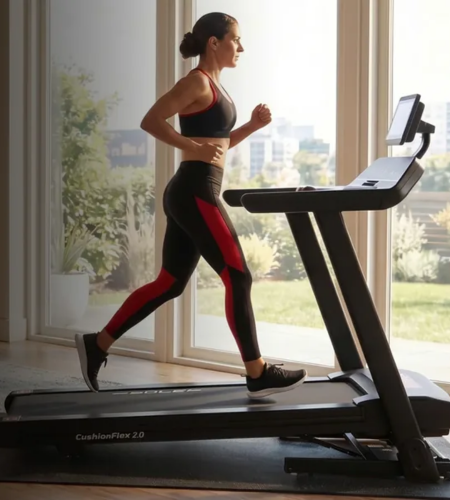
A treadmill can look manageable online but feel much larger once it arrives. Measure the room, doorway, hallway, ceiling height, and intended workout area before ordering.
Do not measure only the treadmill’s footprint. Check its operating dimensions, folded dimensions if applicable, and the manufacturer’s recommended clearance. Folding models can make storage easier, but they still require substantial space while being used. SOLE’s current range includes several folding models, including the F50, F63, F65, F80, F83, and F85.
Delivery access matters too. SOLE says treadmills generally ship by freight, and room-of-choice and assembly services are available as delivery upgrades.
3. Compare the Running Deck
Deck size should match your stride and workout style. A shorter or narrower surface may work well for some walkers, while runners often benefit from additional room.
SOLE’s current lineup illustrates the differences. The F50 has a 20-by-55-inch running surface, the F63 and F80 use 20-by-60-inch decks, and the F83 and F85 offer 22-by-60-inch surfaces.
If you are tall, have a longer stride, or expect to run regularly, pay particular attention to deck length and width rather than choosing based only on the treadmill’s overall dimensions. Current treadmill-buying guidance also emphasizes matching belt dimensions to the user’s stride and intended activity.
4. Look at Motor, Speed, and Incline
Consider motor specifications based on your routine, as frequent running may require more than occasional walking.
Incline adds variety to walking, running, and interval workouts, with SOLE models ranging from 0–12 on the F50 to 0–15 on models like the F63, F65, F80, F83, and F85. The TT8 also offers decline from -6 to 15, so match the speed and incline to your planned workouts instead of choosing the highest specifications.
5. Choose Features You Will Actually Use
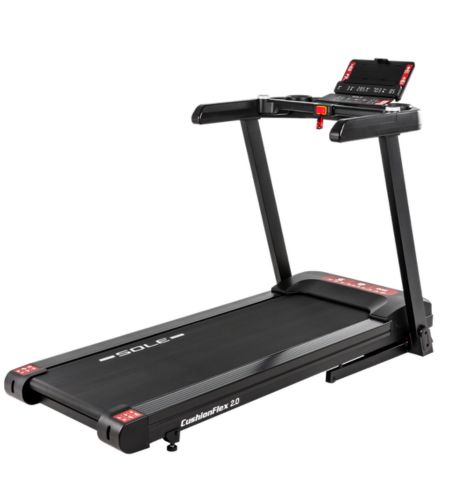
Modern treadmills can include touchscreens, streaming support, Bluetooth, speakers, workout programs, and app connectivity. These features can be useful, but they should not distract from fundamentals such as deck size, stability, speed, incline, capacity, and storage.
For example, the SOLE F80 has a 10.1-inch touchscreen, while the F85 uses a 15.6-inch touchscreen. The F63 uses a white LED display. SOLE also states that its current equipment does not require a monthly membership and includes access to the SOLE+ app.
If you already use a tablet for entertainment, a simpler display may be enough. If integrated streaming is important to your routine, a larger touchscreen may provide more value.
6. Compare SOLE Models by Your Needs
SOLE’s current treadmill lineup spans several price and specification levels. The F50 is listed at $999.99 with a 20-by-55-inch deck and 0–12 incline. The F63 is $1,099.99 with a 20-by-60-inch deck and 0–15 incline. The F80 is $1,599.99 with a 3.25 HP motor, 20-by-60-inch deck, and 10.1-inch touchscreen. The F83 is $1,799.99 with a 22-by-60-inch deck, while the F85 is $2,199.99 with a 3.5 HP motor and 15.6-inch touchscreen.
These are current listed prices and can change, so verify the official store before purchasing.
7. Check Capacity, Warranty, Delivery, and Returns
Specifications are only part of the decision. Check the maximum user capacity and warranty for the exact model you are considering.
SOLE’s current comparison shows lifetime frame and motor coverage across its main treadmill range, while parts coverage varies by model. For example, the F63 lists two years for the deck, electronics, and wear items/parts, plus one year of labor.
Delivery should also be planned. SOLE lists standard delivery at about 10–14 business days depending on location, with curbside, room-of-choice, and assembly options available.
Direct purchases also have a 30-day satisfaction guarantee, but SOLE currently states that cardio-equipment returns are subject to a $300 return shipping charge plus a 10% restocking fee.
🎉 Save More on Every Order – Grab the Latest Coupons & Deals
Frequently Asked Questions
What should I consider first when choosing a home treadmill?
Start with your primary workout type, available space, number of users, and budget. Then compare deck size, motor, incline, speed, capacity, and features.
Is a folding treadmill better for a small home gym?
A folding treadmill can make storage easier, but it does not eliminate the need to measure the machine’s full operating footprint and storage area.
What treadmill deck size is good for running?
Choose enough length and width for your stride and running style. Current SOLE options range from 20-by-55 inches to 22-by-60 inches, so compare the actual running surface rather than overall machine size.
Does treadmill incline matter?
It matters if you want hill-style walking, running, or interval workouts. Compare the incline range with the sessions you actually plan to perform.
Do I need a touchscreen treadmill?
Not necessarily. A touchscreen can be useful for integrated entertainment or streaming, but it is not essential if you mainly want straightforward walking or running.
Related Resources
For a broader look at SOLE equipment, see the SOLE Fitness Reviews: The Ultimate Guide to SOLE Treadmills, Ellipticals & Home Gym Equipment.
Conclusion
Learning how to choose the right treadmill starts with matching the machine to your real-life training needs. Measure your space, consider your stride and workout style, compare motor and incline capabilities, and decide which technology adds genuine value. Then review capacity, warranty, delivery, and return terms before placing an order.
SOLE Fitness offers a broad current lineup, from the F50 to larger, more feature-focused models such as the F80, F83, F85, and TT8. Comparing those specifications can help you narrow the choices without paying for features that do not fit your routine.